
Read time 03-05 minutes
Buri means old, and the word “Ganges” is known by all of South Asia. The name itself shows this was the old channel of the Ganges, which changed its course over time due to natural shifts. Mughal fell in love with this river and made it the heart of Bengal. That same river is now used as an example of tragedy. TRAGEDY Yes, you heard me right. A river whose water once used to be crystal clear. People used to use the river water to wash their bodies and to drink-yes, TO DRINK. Now the shakar fish, which can live anywhere, can’t even survive in this river. The water now is so dark that it would embarrass any other river to be called one. Buriganga is now nothing but a waste hauling container. Buriganga is no longer a river. It is everything but a river; just name it. Drainage system? Yes. Dumping station? Yes, roads? Yes.
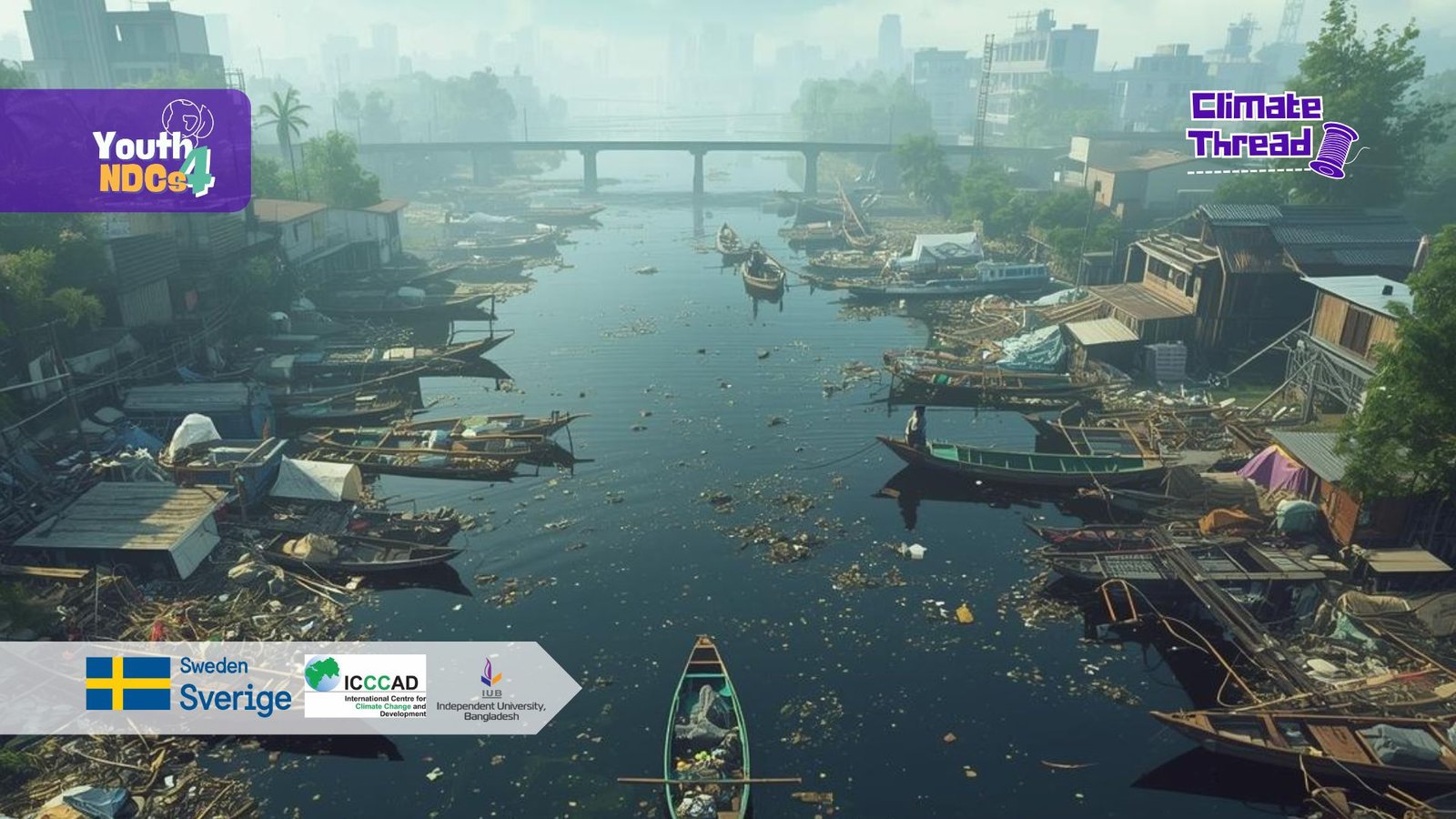
This is a picture of Buriganga. Can anyone see the river? No I can’t, I bet you can’t either. The (non) existing little water part is covered by invasive species called water hyacinths, locally known as Kochuripana. Kochuripana never used to exist in this river from the very beginning. It came from outside of Bangladesh. The peekaboo part you see is basically a waste dumping zone. And the development that is going on is the future road for everyone to use in the near future. An open question: do we know boats? And another follow-up question: do we know that we can also use boats for transportation purposes? Hence, we can easily say that Buriganga is everything except a river. The Buriganga could have been a great support system for the people living nearby and people all over Dhaka. Buriganga could have been the livelihood for many people. Buriganga once was a space for many organisms. Many species used to live nearby and in the river. We lost them all. Even if we humans think we can use natural resources for our own development, have we really used them right? The inhabitants of the capital of Bangladesh alone throw around 4,500 tonnes of solid waste into the river every single day. And according to the Ministry of Environment, tanneries dump about 21,600 cubic meters of toxic waste into the Buriganga daily.
Again, did we certainly use it right? Industrial waste dumping zone- was this the best option we had in our hands? The Buriganga is not only a river, it also has immense cultural significance. The name Buriganga used to appear in songs, poems, and paintings as a symbol of life. It is often used to compare with women in terms of beauty. The river, which once used to reflect the sky, now swallows city waste. Because of the Tragedy called industrialization, we lost the life of dhaka city. We lost the spirit and fierce buriganga.
Still, little hope keeps flaming in my heart that yes, we can still save our Buriganga. But in order to save the buriganga we need to be “WE”. A collective approach and community engagement in order to save the Buriganga is needed. If we collectively come together with a strong motivation to save the river, we can.