
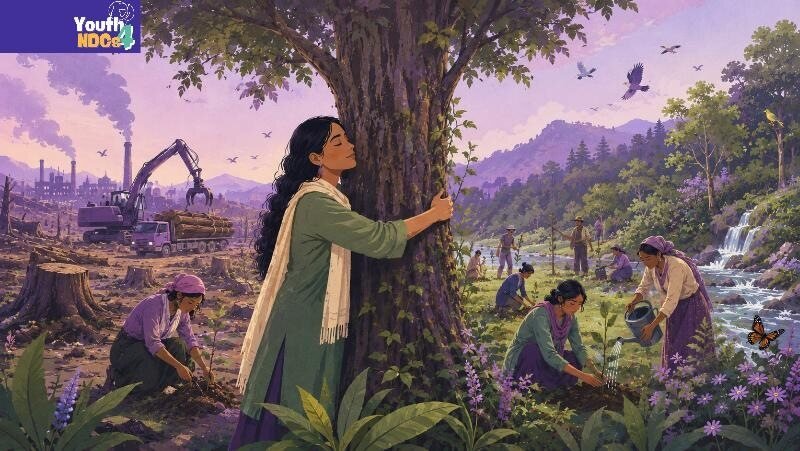

“Women and nature have been the targets of the same forces of domination. To heal one, we must heal the other.”
— Vandana Shiva, ecofeminist and environmental activist
Ecofeminism is a social movement that has emerged from both political activism and intellectual criticism. Studies show that women are more likely than men to be impacted by climate change and 80% of people displaced by climate change are women. While combining feminism and environmental activism, ecofeminism directly addresses the fact that the domination of nature and the oppression of women are the same crisis, driven by the same patriarchal and capitalist systems.
In the early 1970s, a group of women in the mountain villages of Uttarakhand in northern India started an extraordinary movement named the “Chipko Movement”. Women from the communities that depended on the forests for food, fuel, and water stepped forward and wrapped their arms around the trunks. Not as a stunt but as a last line of defense against logging contractors, the state, and a system that saw both the forest and female bodies as raw material to be used up and moved on from. “Chipko” means “To embrace” in Hindi. That image of a woman standing between a bulldozer and a tree captures something ecofeminism has been arguing for decades. The land and women have always been governed by the same logic. Both exist to be exploited. What made Chipko ecofeminist was the understanding that the destruction of the forest was inseparable from the oppression of women. It eventually led to a ban on commercial logging in Himalayan forests, and “Chipko” won.
Moving on, Wangari Maathai founded the Green Belt Movement in Kenya in 1977 with a simple, radical idea which is to give women trees to plant. Over the following decades, the movement planted over 51 million trees, restored degraded land, and put income and agency into the hands of rural women excluded from both. Wangari Maathai was beaten, imprisoned, and mocked by the Kenyan government, but she kept planting. It was never just an environmental project. Women who planted trees also learned to organize, challenge local corruption, and demand accountability from the state. When Maathai as the first African woman accepted the Nobel Peace Prize in 2004, she expressed,
“We cannot tire or give up. We owe it to the present and future generations of all species to rise up and walk.”
In 2016, there was another raised movement calling itself Water Protectors. Thousands of indigenous women gathered at Standing Rock in North Dakota to oppose the Dakota Access Pipeline. It caused threats for the water supply of the Standing Rock Sioux Nation. For many Indigenous communities, the relationship between women and land is not metaphorical but it is universal and lived. The Standing Rock reminded the broader activist world that ecofeminism is not a new idea. Indigenous communities have practiced it on their own terms for as long as colonialism has existed.
The ecofeminist tradition is not history. Women and girls in the Global South are disproportionately harmed by climate change and yet the role of gender in environmental justice remains largely invisible in mainstream policy. Women-led movements are filling that gap. Grassroots organizations across Bangladesh, Bolivia, and Mozambique lead adaptation work rooted in local knowledge. Even activists like Vanessa Nakate from Uganda insist on making the intersection of race, gender, and climate impossible to ignore. In the book, “Ecofeminism: Feminist Intersections with Other Animals and the Earth” published in 2014, Carol J. Adams and Lori Gruen address that “Ecofeminism is a dynamic political theory that identifies how oppressions are interconnected. Also, in arguing relationally and developing a care tradition in animal ethics, ecofeminists were challenging, not accepting, the essentializing structure of the division between men as rational and women as emotional.”
Thus, ecofeminism asks us to notice who is on the frontlines of environmental harm, who is leading the resistance, and to question movements that claim to love the earth while replicating the hierarchies that are destroying it. Most of all, it asks us to imagine differently, not just a world with lower emissions, but a world that is organized around care. The women who hugged trees in Uttarakhand, planted tons of trees in Kenya, and stood in the water at Standing Rock did not wait for a theory. But the theory matters, it connects their struggles to ours, and to everyone fighting for a world that sustains life rather than consuming it.
Zawata Alam
Student
Department of English
Southeast University